All guidesTemplateArtwork, releases and live shows
What goes in a tech rider, with a template to copy.
A tech rider is the document a band sends a venue to say what it needs on stage: who stands where, every input, the monitor mixes, the gear it’s bringing, the gear it’s asking the house for, and who to call. A hospitality rider is a separate list of what the band asks for offstage, such as food, drinks and a place to change. The free stage plot maker on Bounce Sessions, the site you’re reading, builds the plot and input list your rider needs, with no account. Read the venue’s own tech spec first, then change the worked example below to fit.
On this page
Build the stage plot and input list for this rider here, then print both.
Open the stage plot makerA rider states what the band needs
The UK’s Musicians’ Union defines a rider as “a document that states the requirements of an artist for a show or event” in Creating Your Own Access Rider. These documents get mixed up, and the band’s and the venue’s can go by the same name.
Scrolls sideways
| Document | Written by | What it says |
|---|---|---|
| Tech rider, or technical rider | The band | What the band needs on stage: the stage plot, input list, monitors, power and gear |
| Hospitality rider | The band | Sound On Sound’s glossary calls it “a list of requests to ensure the comfort of the artist(s)”, such as dressing rooms, food and drink, and guest tickets |
| Access rider | The musician | The Musicians’ Union says it outlines “your disability or access needs” so people you work with can ensure “equal access to work” |
| Venue tech spec | The venue | What the room has: stage size, desk, monitors, mics, backline and power |
On its Tech Specs and Stage Plots page, the Musicians’ Union calls the band’s document a tech spec, the same name venues use for theirs, so check which one someone means. We found no definition of “band rider” from any organization. In this guide it means the band’s whole rider, the tech and hospitality parts together.
Read the venue’s tech spec before you write
A venue’s tech spec shows what your rider has to fit. This table takes details from four published specs and shows what to do with each. Specs read 3 November 2026. They change, so read the current one for your show.
Scrolls sideways
| Check | What real specs state | What your rider does |
|---|---|---|
| Stage size | Hollywood Theatre, Vancouver (May 2026): 30 ft 10 in wide and 17 ft deep, with an 8’ x 8’ drum riser. Northern Sound System, South Australia (2026): 24ft x 12ft. | Check your layout fits, and allow for the riser. Say if the layout can change on a smaller stage. |
| Inputs | Northern Sound System lists “1 X 20CH STAGE BOX”. Hollywood Theatre lists a 48x24 stagebox. | Count your channels, and ask if you’re close to what’s listed. The example below uses 12. |
| Monitors | Center Stage, Atlanta (2024): 12 wedges and “9 Wedge mixes + cue”. Hollywood Theatre: 8 monitor loudspeakers and “24 monitor mixes available onstage”. | Wedges and mixes are separate counts. Ask for the mixes you need, and say who can share if there are fewer. |
| Mics and DIs | Hollywood Theatre itemizes them, including 8 Shure SM58s, 5 SM57s and 7 Radial passive DIs. Center Stage says “Various Professional Quality Microphones”. Treefort Music Hall, Boise says “Shure, Sennheiser, and Radial full complement”. | Say what you’d prefer and what you’re bringing. If the spec doesn’t itemize, ask before you count on a particular mic. |
| Backline (drums and amps) | Treefort’s house drums come with “no snare or cymbals”. Northern Sound System lists a five-piece Pearl kit plus bass and guitar amps. Center Stage’s sheet lists backline rental companies. | Say what you’re bringing. If you’re using a house kit, check what’s missing from it. |
| Stage power | Treefort lists 20-amp 120V outlets by position: downstage floor, upstage wall and both side walls. | Say where you need outlets, on the plot or in your notes. |
| Load-in and parking | Treefort lists a “100’ push” for load-in and parking “Provided – location, per advance”. Center Stage says bus, trailer or truck parking “must be advanced with your show contact 10 business days before arrival”. | Say what you’re driving. Ask for the load-in time and where to park. |
| House rules and costs | Hollywood Theatre doesn’t permit glitter or confetti, lists “A cleaning fee ranging from $350 to $3,000” (the sheet names no currency; the venue is in Canada), and says haze must be approved in advance. Center Stage lists “Merchandise: 20% venue commission”. | Clear any effects with the venue first. Ask about merch terms before you price your merch. |
Treefort lists a standing capacity of 1,041, Center Stage 1,050 and Hollywood Theatre’s standing floor plan 594. The Northern Sound System sheet gives none. A smaller room may publish less, or nothing. If you can’t find a spec, ask the venue what the house has before you send your rider.
What a small band’s rider needs
This section draws on two Musicians’ Union pages, both written for the UK: Tech Specs and Stage Plots and Engagement Booking for Unsigned and Emerging Artists. Start with the Union’s limit: “Keep it to what ‘you’ genuinely need.” Sound On Sound’s glossary also lists lighting, staging and crew, which a bigger production might ask for. Leave out whatever your show doesn’t use.
Contact and date
Put a name and phone number at the top, with the date you last changed it. The Union says to make it “up-to-date and relevant to the specific event”, and not to “reuse an old spec and then try to improvise it on the night.”
Stage plot
Show the “names of musicians, their instruments and where they are positioned on stage.” Our stage plot and input list guide covers how to draw one, and the stage plot maker builds it for you.
Input list
Number every channel. The Union calls this a channel listing, and says to mark “where DI input, XLR or +48v phantom power are required.” Name the mic you’d prefer, accepting that “the actual mic used may be down to the venue”, and say whether each stand is “short or tall boom, straight or overhead.”
Monitors
Say how many mixes you want, who hears each one, and whether it’s a wedge or in-ears. The Union says that if you need an “‘in-ears’ mix feed or a monitor”, you should put it on the stage plot and highlight it.
Power
The same line covers mains power. Its “13a power” is a UK term, so write what applies where you’re playing, or mark each spot that needs an outlet.
Backline and what you bring
Separate what you’re bringing from what you’re asking the house for. The booking guide’s questions are the ones to ask: “Will the backline be provided? Are you required to share any of your gear with other artists?” The Union also says a vocalist “should have his or her own microphone”. If yours does, mark that channel as the band’s.
Times and parking
The booking guide lists load-in and load-out times, parking, the time and length of the soundcheck and performance, and doors. It says these “should be provided at an agreed time e.g., no later than 14 days before the performance”. You may not know them when you send the rider, so the example asks for them.
Access
“If you have any access requirements make the venue and the production team aware.” The Union’s access rider article links to its template for a separate access document.
For a longer real example, the Union publishes a Tech Spec Example from a five-piece band that brings its own in-ear monitor rack. It runs to nine pages, so don’t take its length as a target.
What the stage plot maker covers
The stage plot maker handles the technical half of the rider. You place up to eight players, list up to 24 inputs, add up to eight monitor mixes, mono or stereo, and add stage notes and a contact. The full printed document carries the stage plot, the input list, “Band brings” and “Venue provides” lists, the monitors, the notes and the contact, on Letter or A4. You can start from a template or import your inputs from a CSV.
It doesn’t write a hospitality rider. Stage notes hold up to 600 characters, so longer text goes in your own document, sent with the PDF.
You can build and print a draft with no account. Saving takes a free account, and the free starter is one saved plot and one saved show across your account. If you want a saved version for each venue or lineup, Live Show Plus or Unlimited keeps as many as you need. The pricing page has the details.
A worked rider to copy and change
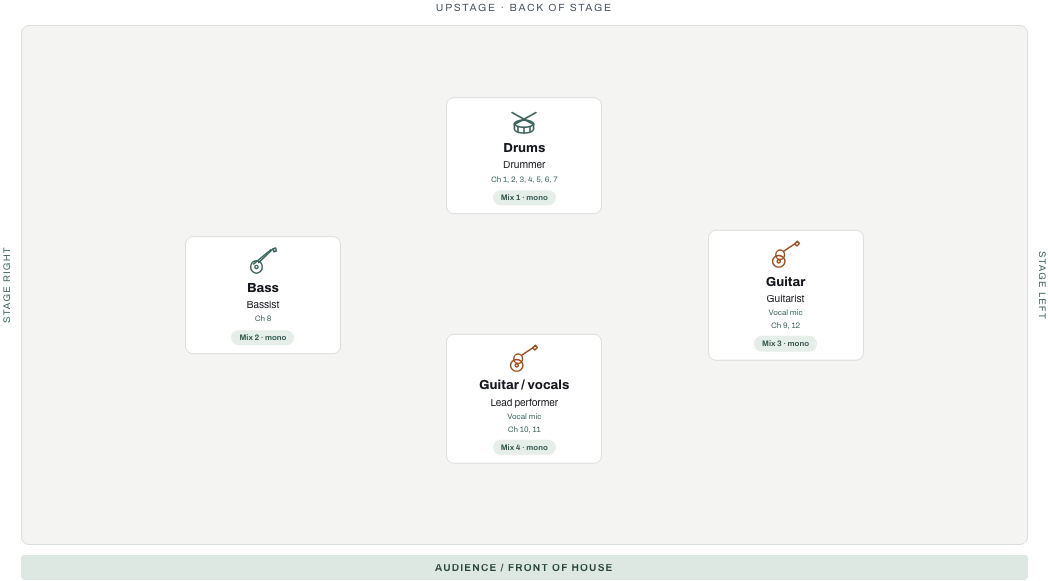
This rider is for an invented four-piece, not a real band. It uses the Rock band starter from the stage plot maker: the diagram is that starter’s, and the input list and four monitor mixes match it. The rest, including the gear, the balances in each mix and the requests, is made up for the example.
Copy the text into your own document, fill in the square brackets and cut what you don’t need.
Scrolls sideways
TECH RIDER: EXAMPLE BAND
Example only, not a real band. Change every detail.

Show:             [venue], [date]
Updated:          [date]
Before the show:  [name], [phone], [email]
On the day:       [name], [phone]

LINEUP
Drums:                  [name]
Bass:                   [name]
Guitar, backing vocal:  [name]
Guitar, lead vocal:     [name]

STAGE PLOT (attached, seen from the audience)
Drums upstage center.
Bass stage right.
Guitar and backing vocal stage left.
Guitar and lead vocal downstage center.
If the stage is small, tell us and we will adjust.

INPUT LIST
Ch  Source           Mic/DI     Stand       48V  By
1   Kick             Kick mic   Short boom  No   House
2   Snare            Dynamic    Boom        No   House
3   Hi-hat           Condenser  Boom        Yes  House
4   Rack tom         Dynamic    Clip        No   House
5   Floor tom        Dynamic    Clip        No   House
6   Overhead L       Condenser  Tall boom   Yes  House
7   Overhead R       Condenser  Tall boom   Yes  House
8   Bass DI          DI         None        No   Band
9   Guitar amp       Dynamic    Short boom  No   House
10  Lead guitar amp  Dynamic    Short boom  No   House
11  Lead vocal       Dynamic    Boom        No   House
12  Backing vocal    Dynamic    Boom        No   House
By = who supplies it. Band = us. House = the venue.
Mic types are preferences. We can work with what the
house has. Tell us before the show if anything changes.

MONITORS
Four separate mono mixes on house wedges.
Mix 1  Drums   kick, bass, lead vocal
Mix 2  Bass    own bass, kick, lead vocal
Mix 3  Guitar  lead vocal, own guitar, own backing vocal
Mix 4  Lead    lead vocal, own guitar
If the room has fewer mixes, tell us and we will share.

WE BRING
Drum kit, unless a house kit is shared for the night.
Two guitar amps and pedals.
Bass and bass DI.
Instrument cables.

PLEASE PROVIDE
Mics, stands and mic cables for the House channels.
Four wedges.
Power at the guitar and lead positions.
A sound engineer for soundcheck and the set.

PLEASE CONFIRM
Load-in and load-out times.
Where to park one van.
Soundcheck time and length.
Doors, set time and set length.
Any backline or gear shared with other acts.

ACCESS
[Add any access needs here, or delete this section.]

NOTES
We will confirm drum mics, amp positions and monitor
mixes with the house engineer.

HOSPITALITY REQUESTS (if the venue can offer them)
Drinking water for four.
A meal or food buyout for four. Dietary needs: [list].
Somewhere secure to leave instruments and bags.
Guest list: [number].
There’s no rider file to download, so copy the text above. Downloads do exist for the plot and input list. The stage plot templates include this rig as a Letter PDF, an A4 PDF and a diagram SVG, and the input list template page has its CSV along with four other rigs. Those PDFs are the generic starter with no contact details. To add yours, open the maker and choose Rock band under Starter templates.
Hospitality rider: things a band might ask for
No organization we found sets a rule for what goes in a hospitality rider. One guide comes from MusicNSW, which describes itself as “the peak body for contemporary music in New South Wales”. Its Hospitality Rider Template page covers meals, dietary requirements, drinks, dressing rooms, towels, mirrors, seating, Wi-Fi, power points and a guest list, and offers a template. The Musicians’ Union’s booking guide says to clarify whether a “Food & drinks rider or buyout” and “Accommodation” are available, and that where possible you should have “a private and secure area with toilet facilities, drinking water and safe storage for personal effects”. A buyout is money in place of food.
The requests at the end of the worked rider are only our suggestions. A band might also ask for:
- Somewhere private to change.
- Accommodation, if you have a long way to travel.
A small venue may not provide any of these, so ask what it can offer before the day. The spec can tell you what’s there: Treefort Music Hall lists two lockable green rooms with showers.
Send it early, then confirm what the venue agreed
Send the rider once the show is booked. The Union’s reason is practical: “most sound engineers prep in advance”. Ask the engineer or promoter to tell you anything they can’t do, then change the rider to match what’s actually happening. Sending it doesn’t show what the venue has agreed to.
We can’t tell you. That depends on what you agreed and where you’re playing, and this guide isn’t legal advice. The sources don’t agree on what a rider is: Sound On Sound calls one a “set of requests/demands”, while MusicNSW calls a hospitality rider “a section of an artist’s contract”. One specific example comes from the UK. In its notes to its L1 and L2 contracts, for agreements “with a consumer” such as a private function, the Musicians’ Union says extra details can go on a separate sheet that “must be signed by both parties and labelled ‘rider to contract’.” If a booker won’t sign its contract, it recommends “a letter or e-mail from them confirming the booking”. If something decides whether the show can go ahead, get the answer in writing, and ask a lawyer or your union where that leaves you.
Sources quoted on this page
Every outside document this guide links to, in the order it first appears. Read 3 November 2026; platforms and plants change these.
- Creating Your Own Access Ridermusiciansunion.org.uk
- Sound On Sound’s glossarysoundonsound.com
- Tech Specs and Stage Plotsmusiciansunion.org.uk
- Hollywood Theatre, Vancouver (May 2026)cdn.prod.website-files.com
- Northern Sound System, South Australia (2026)bookableblob.blob.core.windows.net
- Center Stage, Atlanta (2024)centerstage-atlanta.com
- Treefort Music Hall, Boisetreefortmusichall.com
- Engagement Booking for Unsigned and Emerging Artistsmusiciansunion.org.uk
- Tech Spec Examplemusiciansunion.org.uk
- MusicNSWmusicnsw.com
- Hospitality Rider Templatemusicnsw.com
- notes to its L1 and L2 contractsmusiciansunion.org.uk